- Details
- Category: Conference
Jeux & Enjeux is a transdisciplinary scientific meeting about serious games and participatory simulations. First and foremost, it is the ideal venue to meet, exchange, and share experiences among diverse users: territorial stakeholders, professionals and/or experts of the serious game sector, researchers, teachers (primary, secondary and higher education), and students. Traditionally, the Jeux & Enjeux meeting puts primary emphasis on multi-player games, whereby interactions among participants are an essential component of the game. This meeting will aim to bring forth a wide range of playful initiatives and to strengthen the dynamics of the collective already engaged for the development of these ludic tools.
Do you design or use serious games and/or participatory simulations as part of collective actions with citizens, professionals, or trainees (students, pupils, adults in professional training)? Do you want to share your experience and discover other initiatives related to these tools? The Jeux & Enjeux meeting has become an essential rendez-vous of the francophone community of users of serious games and participatory simulations.
This 5th edition will focus on recent experiments carried out about, in, or with territories using serious games and participatory simulations, and on learning and transfer actions related to these initiatives. Yet, any original propositions are welcome.
The call to abstract and further information are available at: https://jeux-enjeux2026.sciencesconf.org/
This meeting is organised by the MSH (Maison des Sciences Humaines) of Dijon and by the ThéMA laboratory, in partnership with Institut Agro Dijon
- Details
- Category: Diffusion

Michael SeyedAlireza Malih is beginning a thesis entitled “Simulation and Analysis of Urban Transport Electrification Using Digital Twins” This thesis will be supervised by Igor Agbossou (UMLP) and Jean-Philippe Antoni (UBE) at the IUT Nord Franche-Comté in Belfort.
Abstract
In the current context of the gradual and sustained adoption of electric vehicles for mobility and transportation needs, the electrification of urban transport has emerged as a global priority, driven by continuous technological innovations and supportive public policies. The SATURN project focuses on exploring and analyzing optimization levers for urban transport electrification by designing urban digital twins to support scientific simulation and visualization of both existing realities and future scenarios.
SATURN therefore aims to develop an integrated framework to model and analyze the complex dynamics of urban transport infrastructure electrification at the scale of the Bourgogne–Franche-Comté Region. The digital twin approach enables realistic modeling of the dynamics of real-world physical and logistical systems, thereby facilitating an in-depth study of the environmental, economic, and social impacts of this ecological transition.
We thus propose a functional and operational prototype of a digital twin dedicated to the electrification of urban transport in the Bourgogne–Franche-Comté Region. Among the scientific challenges inherent to such a solution are: 3D data acquisition and integration from heterogeneous and multi-source datasets, the implementation of mobility models, the variability of electricity demand, and spatial constraints.
- Details
- Category: General public
The third-year students of the undergraduate program in geography are pleased to invite you on the 16th of December 2025 for a presentation of higher education programs in geography, mostly dedicated to university programs.
Whether you are simply curious, already interested in land planning, or thinking about your future career, this event is open to all and will make you discover the contents of geography study programs. The list of career opportunities offered after such a training will be presented, including careers in land planning, urbanism, transport and mobility management, environment, geomatics, mapping, among others.
This day will be ideal to exchange, ask questions and meet students to get a better overview of what geography can offer you!
- Hours: 9:30 to 17:30
- Venue: MSHE Claude Nicolas Ledoux, 1 rue Charles Nodier, Besançon
- Contact:
This email address is being protected from spambots. You need JavaScript enabled to view it.

- Details
- Category: Dissertation Defence

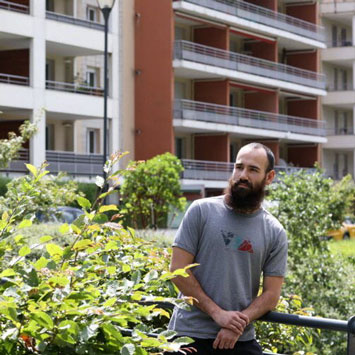
This thesis, entitled "Residential trajectories and modes of inhabiting: an analysis of the role of green amenities in residential preferences and leisure activities in urban areas" was directed by Samuel Carpentier-Postel and Samy Youssoufi.
The defense will take place in the UFR SLHS (Grand Salon), 32 rue Mégevand in Besançon, at 1:30 pm.
Jury composition
Lise BOURDEAU-LEPAGE, University Lyon 3, reviewer
Samuel CARPENTIER-POSTEL, University Marie and Louis Pasteur, Besançon, thesis supervisor
Geoffrey CARUSO, University of Luxembourg, examiner
Ghozlane FLEURY, University of Nantes, reviewer
Thierry RAMADIER, CNRS, Strasbourg, examiner
Samy YOUSSOUFI, University Marie and Louis Pasteur, Besançon, thesis co-supervisor
Abstract
The suburban detached housing model today appears to be reaching its limits. Its sustainability is increasingly questioned, both because of its contribution to land artificialisation and the car dependency it generates. Land-use sobriety policies, embodied by the objective of “zéro artificialisation nette” (ZAN), restrict the future prospects of access to such housing forms, which nonetheless remain strongly favoured by a large proportion of households. Alternatives such as intermediate housing do exist; however, rethinking the residential offer beyond the suburban imaginary requires engaging individuals’ residential aspirations and preferences, in order to design spaces that truly meet expressed needs. Access to green amenities constitutes one of the key factors underpinning the attractiveness of suburban areas. Within this framework, this thesis focuses on residential preferences and the roles attributed to urban green amenities, through an examination of the psychological, sociological, and geographical factors that shape them. The relationship to green amenities is approached through the lens of leisure and residential mobility.
A mixed-methods approach, combining quantitative and qualitative perspectives, was employed. A questionnaire survey conducted in the urban areas of Dijon and Besançon included a photo-questionnaire to assess residential preferences; a mapping tool to collect data on leisure activities in green spaces; and a set of questions addressing sociodemographic profiles, housing conditions, and residential trajectories. Four types of resident profiles were constructed and then integrated as explanatory variables in behavioural models relating to both residential preferences and leisure mobilities. Semi structured interviews were carried out with a subsample of respondents to further analyse the links between residential trajectories and preferences, exploring social representations of the “ideal home” and their relationship with settlement identity.
The results show that detached housing remains strongly preferred. However, some resident profiles express more favourable attitudes towards collective housing forms that are in line with densification goals. The modelling of leisure mobilities reveals a significant effect of resident profiles on the use of green spaces, while accessibility levels to these amenities do not play a significant role. The interviews highlight discrepancies between settlement identities and residential experiences, particularly because other life domains influence the interpretation of residential trajectories, thereby underscoring their subjective dimension. Overall, the findings suggest that moving away from the suburban detached housing model remains difficult for many individuals. Nevertheless, for some identified resident profiles, it would be relevant to encourage reflection on diversifying housing forms both in cities and in nearby suburban areas, with an approach more closely centred on individual needs. In this perspective, green amenities, as public spaces, play an essential role in making the city desirable.
- Details
- Category: General public
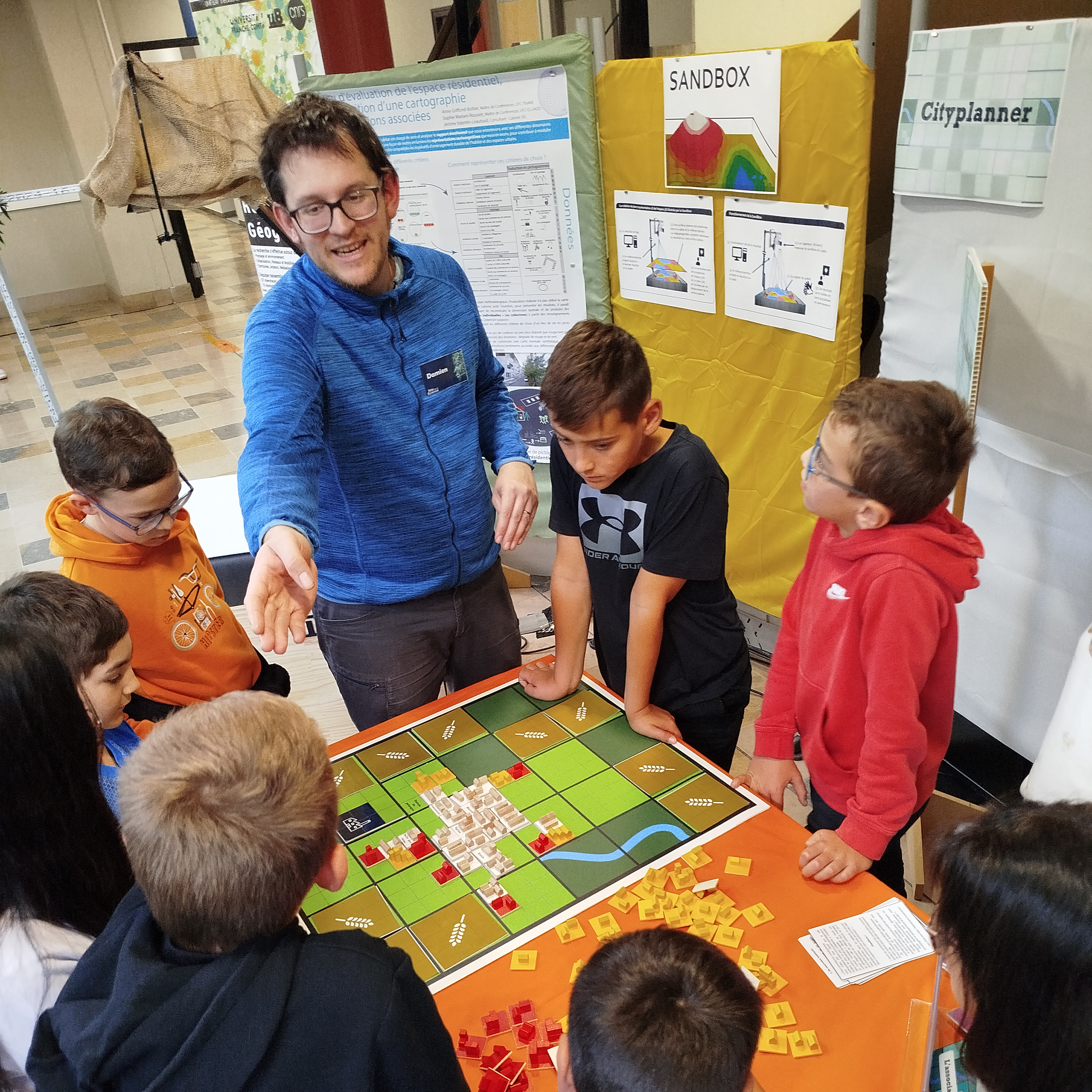
Again this year, ThéMA was present at the "Fête de la science" from 9 to 12 October 2025, alongside about 30 other laboratories as well as museums' and associations' representatives. During this edition, at the booth of the ThéMA laboratory, people could discover the SandBox and the serious game CityPlanner.
The SandBox is a geospatial technology modelling fields in augmented reality. It consists of a machine connected to a computer, which carves a landscape in a sand box before numerising the topography of the obtained field. The ThéMA SandBox was developed by Damien Roy. During the demonstration, visiters could observe the 2D topographic modelling in real-time, thanks to an interactive display.
CityPlanner is a serious game developed by members of ThéMA and of the Luxembourg Institute of Socio-Economic Research (LISER), in partnership with the Compagnie des rêves urbains. The players of this board game discover the chief principles of land planning by planning collaboratively the development of a small town while making sure they respect sustainable planning rules.

- Details
- Category: Conference

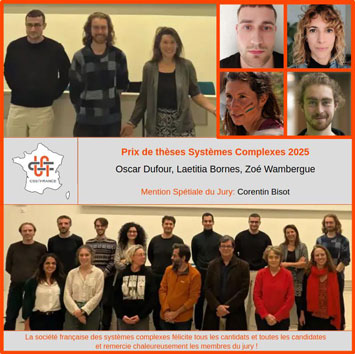
The examination for the Thesis prize Complex Systems 2025 helded on the 10th of October in Besançon.
Among the twelve presentations of the candidates, four were particularly appreciated. The committee deliberated for a long while before awarding three theses:
Oscar DUFOUR : Enhanced agent-based models for pedestrian crowds : insights from empirical data at the Festival of Lights and refinements of mechanical interactions, pedestrian shapes, and decisional aspects
Laetitia BORNES : Méthodes et outils systémiques concrets pour faire face à la complexité environnementale et aux effets rebond pendant un processus de design ou de décision
Zoé WAMBERGUE : De l’autre côté du couvercle : Trajectoires détritiques d’acteur·ices des déchets à Nantes Métropole
A special mention (without associated prize) was granted to:
Corentin BISOT : Bridging scales in the Arbsucular Mycorhizal Symbiosis
Felicitation to all candidates!
- Details
- Category: Job
"The ThéMA laboratory is seeking a post-doctoral researcher to work on the coupled modelling of population genetic structure and metacommunity dynamics in habitat networks. The project will start in early 2026 (flexible start date), for a duration of 24 months.
The candidates must have completed a PhD in ecology or population biology by January 2026, ideally specialized in community ecology, landscape ecology, urban ecology, population genetics, or landscape genetics. Solid skills in geomatics and programming (QGIS, R, optionally : PostGIS, Julia, Git, use of computation cluster) will be appreciated.
Applications are expected by November, 16th and should be sent to Paul Savary :
Please find more details here
- Details
- Category: Conference
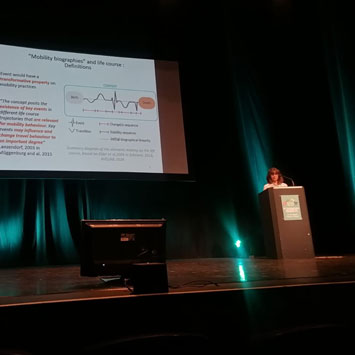
This event will take place on Friday, October 10, 2025, from 9:30 a.m. to 6:30 p.m. at the Maison des Sciences Humaines et Environnementales Claude-Nicolas Ledoux, 1 rue Charles Nodier, in Besançon.
This national award is intended for theses in the field of complex systems. This field is transdisciplinary and encompasses subjects ranging from computer science to geography, including linguistics, history, physics, biology, epidemiology, and ecology. What unites them is the way in which systems are organized: interacting elements that give rise to emerging phenomena.
This symposium will be an opportunity to hear the finalists for the prize present their thesis work to a multidisciplinary jury and discuss the scientific and methodological issues related to complex systems. You will be able to discover innovative contributions in a variety of fields, exchange ideas with young researchers and jury members, and participate in a highlight of complex systems research.
The full program is available here: 2025 Complex Systems Thesis Prize --- Program.
The entire day will be broadcast live on Zoom: 2025 Complex Systems Thesis Prize --- Video link
Laboratory contact:
- Details
- Category: Publication and Output

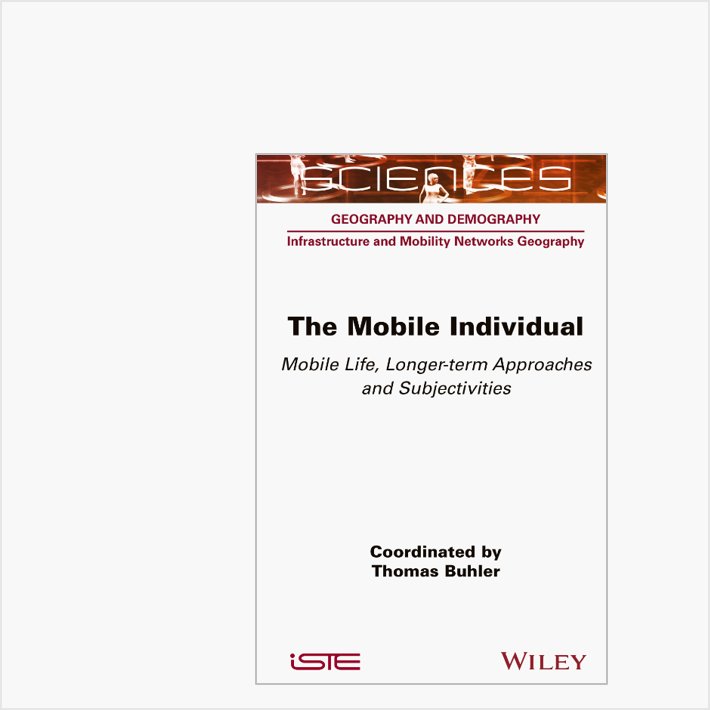
Digital data, graph theory and spatial modeling allow us to apply the concepts of centralities and hierarchies to a wide variety os spatial situations.
The authors of this book offer insight into centralities and hierarchies within networks and territories at different scales and temporalities and for different socio-economic phenomena.
The first part of the book explores the contribution of data from cell phones and social networks to understanding centralities and hierarchies of urban space within a circumscribed temporality. The second part uses network analysis – ecological networks, media networks and scientific knowledge networks – to propose indicators of spatial organization that reveal the centralities and hierarchies of spatial systems. Finally, in the third part, the territorial processes behind the formation of centralities and hierarchies are presented from a long-term perspective.
https://www.iste.co.uk/book.php?id=2267
Funded PhD project: Modeling and simulation of urban transport electrification through digital twins
- Details
- Category: Job
The energy transition necessitates a rapid electrification of urban transport systems. This PhD project aims to design and experiment with an innovative digital modeling of electrified transport networks, leveraging digital twin technologies.
The project fits within a large-scale prospective simulation perspective, using 3D spatial data, territorial indicators, and multi-agent or geosimulation approaches.
The objective is to propose operational electrification scenarios adapted to the territories of the Bourgogne Franche-Comté region.
Research laboratories involved are ThéMA, Femto-st and CRESE. The thesis will begin in October 2025. The call for application is open until the 15th of September 2025. Please send the following by email to