Sélectionnez votre langue

Sélectionnez votre langue
Sélectionnez votre langue
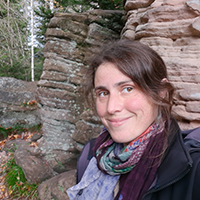
Manon Kohler est chercheuse au CNRS au sein du laboratoire ThéMA (Théoriser et Modéliser pour Aménager) du CNRS-Université de Franche-Comté.
Elle s'intéresse particulièrement à la biométéorologie humaine et à l'adaptation des sociétés à la chaleur. Elle apprécie la découverte de nouvelles cultures, la randonnée en haute et moyenne montagne et la photographie.
Mots clés : climat urbain, biométéorologie humaine, géographie, forme urbaine durable et analyse spatiale, adaptation aux excès de chaleur.
Manon a obtenu son doctorat en Géographie physique à l'Université de Strasbourg en 2015 (UMR CNRS LIVE), où elle a appliqué le modèle atmosphérique régional WRF et sa paramétrisation urbaine BEP+BEM à l'aire urbaine de Strasbourg afin d'évaluer l'impact des politiques de développement urbain sur la demande énergétique des bâtiments et le climat urbain. Elle a participé à l'ANR Trame Verte Urbaine (2009-2012, co-développement du modèle numérique d'interfaçage de canopée urbaine CIM) et, a poursuivi ses recherches sur le climat et les formes urbaines durables (smart green cities) lors de son expérience post-doctorale à l'Institut Leibniz IOER de Dresde (Allemagne, collab. Dr. Martina Artmann).
En 2017, elle a rejoint l'Université de Singapour (NUS), puis la Singaporean Management School (SMU) au cours des initiatives multi-institutionnelles Cooling Singapore 1.0 et 1.5 (ETH-Z/NUS/MIT/TUM/A*Star). Elle y a piloté plusieurs campagnes d'observation biométéorologique humaine (fixes et mobiles) visant à diagnostiquer le confort/stress thermique des piétons dans les quartiers de Singapour afin d'intégrer les conceptions architecturales et urbanistiques favorables à la santé dans les documents d'urbanisme de la ville-état et a travaillé en collaboration avec le Dr Negin Nazarian (UNSW-Sydney) et A/P Jason Lee (NUS) au projet de recherche "Coolbit" pour développer une méthode de personnalisation du diagnostic du confort/stress thermique à l'aide des montres connectées-santé.
Depuis son retour en France, ses intérêts de recherche vont des questions méthodologiques, telles que la fiabilité des mesures météorologiques et humaines du stress thermique dans les villes ou le développement de capteurs météorologique bas coût, à des questions plus fondamentales sur les "espaces refuges" ou orientées "action" sur les stratégies d'adaptation des individus et des territoires (ruraux et urbains) à la surchauffe.
Direction de Réseau :
- co-directrice du Réseau Prospectif CNRS SHS Climat Ville et Société au côté de M. Hendel (LIED Paris) et A. Rodler (CEREMA Nantes) - 150 membres
Autres activités :
- membre de la Zone Atelier Environnementale Urbaine (ZAEU)-équipe Energie, Pollution de l'air, Climat
- membre du panel d'experts scientifiques du GIEC régional GREBE-Climat (Franche-Comté/Bourgogne)
- membre des axes 2, 3 et 4 du Réseau Prospectif CNRS SHS Climat Ville et Société
- comité de lecture pour : Urban Climate (3), Bulletin of the American Meteorological Society (2), Urban Forestry & Urban greening (1), Atmospheric Chemistry and Physics (1), Buildings (1), La Météorologie(1), International Journal of Biometeorology (1).
Projet en cours :
- présent - 2025 : projet ANER région Capbiomet : Diagnostic du stress thermique des habitants de Franche Comté et identification des espaces refuges de la population pour une meilleure gestion des flux de population et préservation des espaces naturelles (50kE, lead)
- présent - 2025: projet Pôle Fédératif de Santé CATS : Canicule, Territoire et Santé pour une planification territoriale de la santé à échelle fine en BFC (15kE, co-lead)
- présent - 2024 : projet Idex de Université de Strasbourg : Changement climatique Alsace-Vosges - traitement de données et synthèse" (lead: PR M.C. Pierret, laboratoire ITES)
- 2023-2024 CNRS-Eurométropole de Strasbourg projet VESPAI : Diagnostic de la vulnérabilité des établissements scolaires strasbourgeois à la canicule (stress thermique intérieur) (30 kE, lead : DR CNRS N. Blond, laboratoire LIVE ; co-lead CR CNRS M. Kohler, collab. OctopusLab)
- 2022-2023 CNRS-Eurométropole de Strasbourg projet PRIMEQUAL AMBRES "Approche multicritères pour un bâtiment résilient et sain" (lead : M. Mendez OctopusLab)
Autres projets internes (en cours) :
- River&bathing : Baignade, pression humaine sur les ressources naturelles en eau et inadaptation à la surchauffe des régions Alsace et Bade-Württemberg.
- Les Weihermatten : valeur ajoutée des petites zones humides (1 ha) pour le refroidissement potentiel des petites villes pendant les vagues de chaleur.
Enseignements :
Depuis 2020 : Niveau licence à l'Université de Strasbourg Dprt Géographie et d'aménagement : Vulnérabilités, Risques et urbanisme favorable à la santé face aux chaleurs extrêmes (pléniers + pratiques, environ 25 heures/an).
Encadrements :
- 2025 : stage PRT de Siméon Gass et Mickael Guerchon - INSA Strasbourg (co-direction)
- 2025 : mémoire de Master d'Arno Lioutier - Faculté de Psychologie Sociale et Environnementale de Nîmes (direction)
- 2025 : mémoire de Master de Lucine Aimé - Faculté de Sciences Humaines et Sociales de Besançon (direction)
- 2024 : mémoire de Master de Laure Chambraud- Faculté de Géographie de Strasbourg (co-direction)
Link ORCID : https://orcid.org/0000-0002-1496-8501
Link researchgate: https://www.researchgate.net/pr
Manon Kohler is a CNRS researcher working at the ThéMA (Théoriser et Modéliser pour Aménager) laboratory of the CNRS-Université de Franche-Comté.
She is particularly interested in human biometeorology and heat adaptation of societies. She appreciates to discover new cutlures, hiking in high and medium range mountains, traditional artcrafts, photography and used to be beekeeper in past times.
Keywords: urban climate, human biometeorology, geography, sustainable urban form and spatial analysis, overheating adaptation.
Manon graduated her PhD in Physical Geography at the University of Strasbourg in 2015 (UMR CNRS LIVE), where she studied the "added value of urbanised regional atmospheric numerical models for the assessment of the impact of urban planning policies on the energy demand of buildings and the urban climate". She participated to the ANR Trame Verte Urbaine 2009-2012, and continued her research on sustainable urban forms during a post-doctoral experience at the Leibniz Institute IOER (risk team FB-R, Dresden, Germany) in collaboration with Dr. Martina Artmann (i.e., smart green cities) and then joined the University of Singapore and the multi-institutional ETH-Z/NUS/MIT/TUM/A*Star initiative Cooling Singapore (2017-2020).
There, she led several fixed and mobile human biometeorological observation campaigns aimed at diagnosing the outdoor thermal comfort/stress of pedestrians in Singapore's neighbourhoods in order to integrate climate-smart designs in urban planning documents. She worked in parallel on the Coolbit project (with Dr Negin Nazarian, UNSW & A/P Jason Lee, NUS) to develop a method to personalise the diagnosis of thermal comfort/stress at the individual level using smartwatches to promote inclusive healthy cities.
Since returning to France, Manon Kohler's research interests have ranged from methodological issues, such as the reliability of meteorological and human heat stress measurements in cities, to more fundamental action-oriented questions concerning the adaptation strategies of individuals and territories to overheating (e.g. additional anthropic pressure on water resources due to bathing activities during heat waves), whether the territories are urban or rural.
- co-direction of the French CNRS SHS research network on Urban Climate (co-dir.: M. Hendel, LIED Paris & A. Rodler CEREMA Nantes)
Ongoing project:
coming soon: 2025-2027 ANER region Capbiomet: Diagnosis of heat stress among the inhabitants of Burgundy-Franche Comté and their natural remote refuge areas (50kE, lead: M. Kohler)
2024 - present: Université de Strasbourg project Changement climatique Alsace-Vosges- traitement de données et synthèse (lead: MC Pierret, PR ITES, FERED de l'Université de Strasbourg et CNRS)
2023-2024 CNRS-Eurométropole de Strasbourg VESPAI project (lead: N. Blond, LIVE; collab. OctopusLab) diagnosis of the vulnerability of schools to heatwave in the Eurometropolis territory (indoor heat stress) - co-direction of the Master thesis of Laure Chambraud.
2022-2023 CNRS-Eurométropole de Strasbourg AMBRES project (lead: M. Mendez OctopusLab + N. Blond, LIVE) Approche multicritères pour un bâtiment résilient et sain
Others internal projects (ongoing):
- River&bathing: identifying the added-pressure on natural water resources due to maladaptation to overheating in the Alsace-Bade-Württemberg region.
- Les Weihermattens: added-value of small humid areas ( 1 ha) for small towns' potential cooling during heatwaves.
Other activites:
- member of the Zone Atelier Environnementale Urbaine (ZAEU), team Energy, Air Pollution, Climate
- member of the scientific panel of experts of the regional IPCC GREBE-Climat (Franche-Comté/Burgundy)
- reviewer for Urban Climate (3), Bulletin of the American Meteorological Society (2), Urban Forestry & Urban greening (1), Atmospheric Chemistry and Physics (1), Buildings (1), La Météorologie(1), International Journal of Biometeorology (1).
Teaching:
- Since 2020: Bachelor level at the University of Strasbourg: urban planning and risk related to extreme heat in urbanized regions (plenary + practices courses, about 25 hours/yr.)
Link ORCID : https://orcid.org/0000-0002-1496-8501
Link researchgate: https://www.researchgate.net/profile/Manon-Kohler